
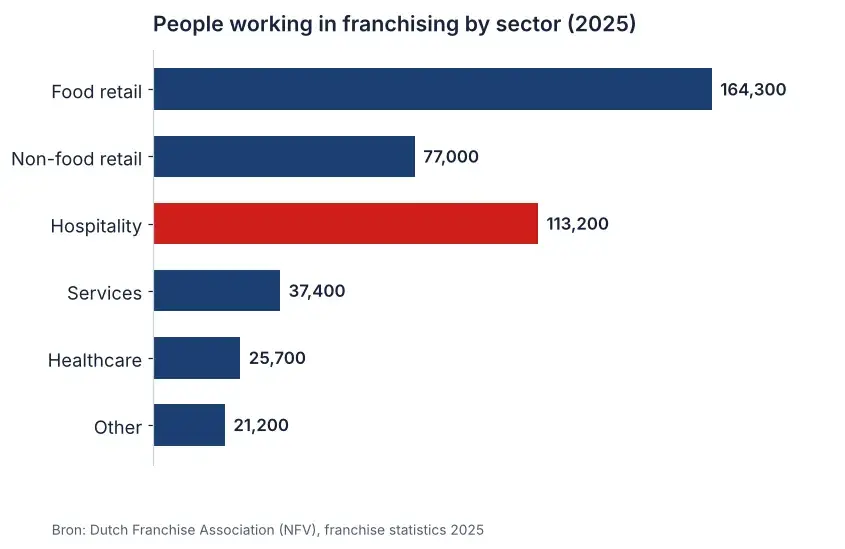
B2B franchise marketing is marketing for franchise brands that sell to businesses, such as accountancy firms, staffing agencies, IT service providers and commercial cleaning companies. The customer journey is longer, more people are involved in the decision and trust weighs more heavily than price. Even so, business customers often search locally: an accountant or staffing agency ‘in the area’. With 375 franchise brands and 9,721 locations, services is the largest franchise sector in the Netherlands (Dutch Franchise Association (NFV), reference year 2025).
What is different about B2B franchise marketing?
In B2B it is less about impulse purchases and more about trust, expertise and a personal relationship with the location.
| Aspect | B2C franchise brand | B2B franchise brand |
|---|---|---|
| Decision | One person, often quickly | Several people, longer process |
| Main channel | Google Maps, social media | Google, LinkedIn, recommendations |
| Conversion | Visit or purchase | Quote request or meeting |
| Reviews | Many, short | Fewer, but carry more weight |
| Content | Promotions and atmosphere | Expertise and case studies |
Why does local visibility matter in B2B too?
Business owners look for an accountant or staffing agency nearby, because personal contact matters to them. That is why every location needs its own Google Business Profile and its own page, featuring the people, specialisms and region. See local landing pages per location and local visibility per location.
The best channels for B2B franchise brands
- Google Search and Maps: for ‘in the area’ queries.
- LinkedIn: to make the franchisee visible as an expert.
- Knowledge articles: answers to questions that AI assistants pick up.
- Reviews: from business customers, with their name and sector.
- Google Ads: on specific services around each location.
You can read how to use LinkedIn to recruit franchisees in finding franchisees via LinkedIn.
Which business franchise brands is this for?
Think of franchise marketing for accountancy firms, franchise marketing for staffing agencies, franchise marketing for IT service providers and franchise marketing for cleaning companies. Each sector has its own page setting out the approach.
Measuring leads per location
In B2B, a single lead is worth a lot. So measure per location: quote requests, phone calls and meetings, and link them to the channel they came from. That way you can see which location wins a lot of work on a small budget.
| Measurement point | Source | Why |
|---|---|---|
| Quote requests | Location page form | Direct demand for the service |
| Phone calls | Business Profile and website | Often the first step in B2B |
| Direction requests | Google Business Profile | Visits to the office |
| Reviews from business customers | Trust among new customers |
Content that convinces business customers
Business customers want to see that a location understands their situation. Content per location therefore works well: a short case study from the region, the team's specialisms and answers to the questions business owners ask. AI assistants also pick up those answers when someone asks for ‘an accountancy firm for hospitality businesses in Utrecht’. Keep the tone businesslike and concrete, and always name the people behind the location. Head office provides the structure and a few examples; the franchisee adds the local knowledge. That keeps quality consistent while the content is still unique to each location. Work to a fixed schedule: one new piece per location per quarter is enough to keep the page alive.
With B2B franchise brands, pay extra attention to the consistency of your details. Businesses often check several sources before getting in touch: the website, Google, LinkedIn and sometimes the Dutch Chamber of Commerce (KvK). If a location's name, address or phone number differs from source to source, it costs trust. So establish one single source of truth at head office and check every quarter whether all channels are still correct. That small bit of discipline prevents missed enquiries and also helps AI assistants to recognise and recommend the location properly.
Start with the two or three locations that receive the most enquiries, record what works there and then roll it out to the rest of the franchise brand.
| Format | Purpose | Who creates it |
|---|---|---|
| Location page with team | Trust | Head office with input from the location |
| Short case study from the region | Proof | Location, edited centrally |
| Questions and answers | Visibility in Google and AI | Head office |
| LinkedIn post by the franchisee | Demonstrating expertise | Franchisee |
| Reviews from business customers | Social proof | Location asks, answered centrally |
Marketing that suits a long sales cycle
Business customers rarely decide after a single visit to a website. A business owner looking for a new accountancy firm often compares several providers, asks around in their network and only gets in touch weeks later. Marketing for B2B franchise brands therefore has to do more than make sure a location is found; it also has to keep that location in view during that period.
You can do this with simple tools: a newsletter with practical tips from the region, a LinkedIn profile for the franchisee that shares something regularly, and a location page that answers the questions that come up in the orientation phase. What matters is that enquiries are followed up quickly and personally. In B2B, a quote request left untouched for two days is often lost to a competitor who calls the same day.
Set out in the playbook within what timeframe an enquiry is followed up and by whom. Measure that timeframe per location, just like the response time to reviews. See also newsletters per location.
Do not forget your existing customers either. In business services, a lot of new work comes from recommendations by satisfied customers. So after a successful assignment, do not just ask for a review, but also whether the customer knows a fellow business owner you could help. A fixed routine for this, with a short email and personal follow-up by the franchisee, often delivers more than an extra advertising campaign. Record how often this happens and count per location how many new customers come in through recommendations; that makes this channel measurable and comparable between locations too.
Combine that count with the reviews from business customers, so you can see which locations are best at making use of their satisfied customers.
| Stage | What the customer does | Marketing per location |
|---|---|---|
| Orientation | Searches and compares | Visible profile and location page |
| Consideration | Asks around, reads reviews | Reviews from business customers, LinkedIn |
| Contact | Requests a quote or meeting | Fast, personal follow-up |
| Customer | Works with you | Newsletter and review request |
Our approach for B2B franchise brands
We start with a scan of three locations, set up profiles and pages around business search demand and put in place a review process that suits business customers. Take a look at all services for franchise brands or start with our free marketing scan.
Frequently asked questions about B2B franchise marketing
What is B2B franchise marketing?
Does Google Maps also work for B2B franchise brands?
Is LinkedIn important for B2B franchise brands?
How do I measure leads per location?
How many B2B franchise brands are there?
What is the difference between B2B and B2C franchise marketing?
What content convinces business clients of a franchise location?
How do you keep a B2B franchise location top of mind during a long sales cycle?
Why is consistent business information especially important for B2B franchises?
How often should a B2B franchise location publish new content?
Sources

Gijs Bodenstaff
Franchise marketer, local SEO and GEO specialist, author
Want more enquiries per location for your B2B franchise brand? Book a call.