
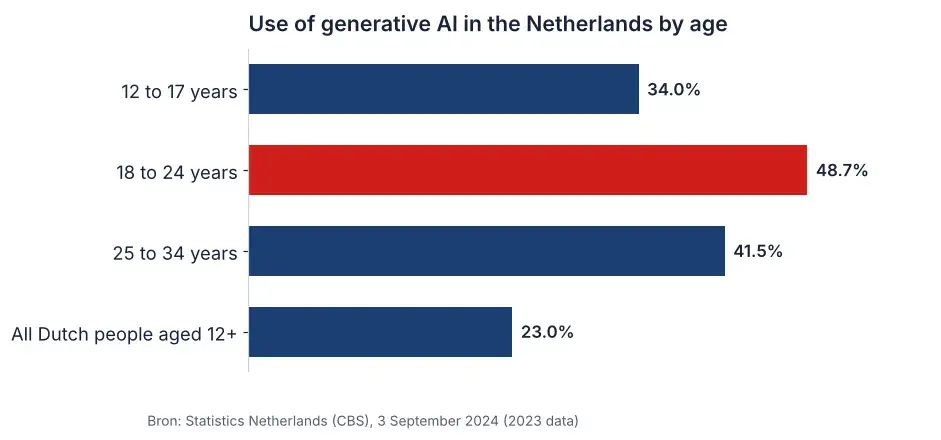
Digital franchise marketing is online marketing for a franchise brand: the website, Google Maps, AI search engines, advertising, social media and email, set up for the brand and for every location. The difference from ordinary online marketing is scale: you are not managing one profile, but dozens or hundreds. And customers increasingly search via AI. According to Statistics Netherlands (CBS), as early as 2023, 23% of Dutch people aged 12 and over created text or images with AI programs such as ChatGPT; among 18 to 24-year-olds this was 48.7%.
Which components make up digital franchise marketing?
Digital marketing for franchise chains consists of six channels. Each channel has a national and a local side.
| Channel | National | Per location |
|---|---|---|
| Website and SEO | Brand and product pages | A location page with its own content |
| Google Maps | Brand consistency | Its own Business Profile |
| AI search engines | Brand facts and FAQ | Local answers per location |
| Google Ads | Brand campaigns | Campaigns around every location |
| Social media | Brand account | Local posts or pages |
| Newsletter | A sender per location |
Why AI search engines make the difference for franchise chains
For a local question, an AI assistant often names only a handful of providers. Which ones depends on what can be found online about each location: the profile, reviews and clear answers on the location page. Chains that only work at brand level therefore disappear from that shortlist. Read more under Generative Engine Optimisation.
The biggest challenge for multi-location marketing: scale and consistency
With a hundred locations you have a hundred profiles, a hundred sets of opening hours and thousands of reviews. Manual work then grinds to a halt. So work with central data (a single source for address, phone number and opening hours), fixed routines and reporting per location. In the benchmark of 100 chains, only 40% of 500 profiles were complete: consistency cannot be taken for granted. See also local marketing for multiple locations.
Digital franchise marketing in five steps
- Baseline measurement per location: Maps, AI and reviews.
- Get the basics right: profiles, NAP and location pages.
- Reviews: a process with a reply within 24 hours.
- Campaigns: Google Ads and social media around every location.
- Reporting: one monthly report per location.
For step 4, paid search campaigns per location help; for the tools, read franchise marketing platforms and software.
Benefits and points to watch
Working digitally makes marketing measurable, but it requires discipline.
| Benefit | Why |
|---|---|
| Measurable per location | Views, direction requests and phone calls are visible |
| Scalable | One process for all locations |
| Quick to adjust | Adjust weekly instead of per season |
| Point to watch | What you do |
|---|---|
| Data becomes outdated | A single central source and quarterly checks |
| Franchisees lose interest | A report per location and a clear division of tasks |
| Too many tools | Choose one platform and keep it simple |
Which figures do you measure per location?
Working digitally only makes sense if you measure per location. Choose a small number of figures and report them every month in the same way. That way franchisees can compare, and you can see which location needs help. Keep the report short: one page per location is enough. Anyone who wants to know more can click through to the details. Also agree what you will do if a location lags behind for three months, for example an extra check of the profile or a conversation with the franchisee. See also measuring ROI per franchise location.
A common mistake is starting with the most fun channels, such as social media or video, while the basics are not yet right. A customer whose curiosity is sparked by an ad or post often then looks up the location in Google. If they find the wrong opening hours, no photos or unanswered complaints, the investment in the first channel is lost. So work from the bottom up: first findable and reliable, only then visible and eye-catching. That sounds less exciting, but it delivers the most per euro and is the easiest to explain to franchisees.
| Figure | Source | Why it matters |
|---|---|---|
| Views in Google | Business Profile | Visibility in the neighbourhood |
| Direction requests and phone calls | Business Profile | Direct customer demand |
| Reviews and response time | Trust and click-through | |
| Mentions in AI answers | Manual or tool-based test | Visibility in AI |
| Conversions from ads | Google Ads | Return on budget |
Who does what in digital franchise marketing?
Digital marketing rarely fails on technology and often on unclear roles. If nobody knows who answers a negative review or who updates a changed phone number, it is left undone. So agree which tasks sit centrally and which with the location, and make that agreement visible in the operations manual. Head office manages the accounts, the data and the campaigns; the franchisee supplies local information, photos and customer stories. When in doubt, a simple rule applies: everything that is the same for every location happens centrally; everything that is only known on the spot comes from the location.
Accounts should always belong to the franchise brand, not to an agency or an individual franchisee. That way you do not lose profiles, reviews or advertising history when you change agency or owner. A clear division of roles also makes it easier to outsource parts later, for example through outsourcing your franchise brand's marketing.
A practical tool is a simple change procedure. If something changes at a location, such as a new phone number, a refurbishment or different opening hours, the franchisee reports it via one fixed form. Head office then makes the change everywhere at once: the website, the Business Profile, social media and any listings in sector directories. This prevents a customer finding the old number in one place and the new one in another, which confuses both customers and search engines. The more consistent the data, the better AI assistants recognise the location and the more confidently they recommend it.
| Task | Head office | Location |
|---|---|---|
| Ownership of accounts | Yes | No |
| NAP data and opening hours | Enters and monitors | Reports changes |
| Photos and local updates | Templates and checks | Supplies |
| Answering reviews | Process and guideline | Input on complaints |
| Campaigns | Sets up and steers | Reports local promotions |
Learn it yourself or outsource?
Does your team want to learn it themselves? Then an in-company online marketing workshop is a good fit. Prefer to outsource? Read online marketing agency for franchises.
Frequently asked questions: digital franchise marketing
What is digital franchise marketing?
Where do I start with digital franchise marketing?
How important is AI for franchise chains?
Should every location have its own website?
Can a franchisee do digital marketing themselves?
How many Dutch people use AI such as ChatGPT?
Which metrics do you track per location in digital franchise marketing?
Why does starting with social media or video often fail for chains?
How do you keep digital marketing consistent across a hundred locations?
Who does what between head office and franchisee in digital marketing?
Sources

Gijs Bodenstaff
Franchise marketer, local SEO and GEO specialist, author
Want to know how visible your locations are online? Request the free scan.