
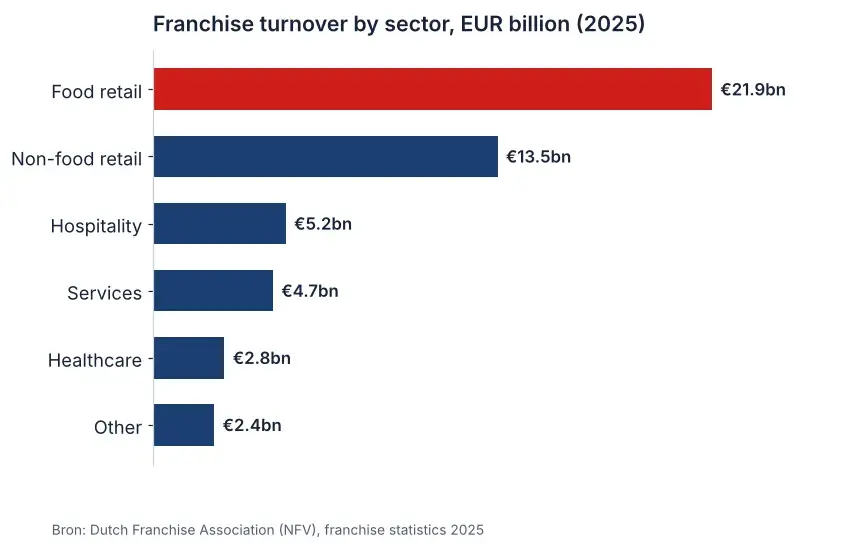
Looking for franchise marketing examples? Below you will find approaches we see working for Dutch franchise brands, organised by sector and by marketing level. We deliberately do not name brands: it is about the pattern, so you can apply it to your own franchise brand. Each example shows what head office arranges and what the location does. The sector figures come from the NFV (reference year 2025), the visibility figures from our own benchmark of 100 chains.
Why examples differ per sector
A supermarket, a hair salon and a home care organisation each have a different customer journey. In food it is about daily visits and special offers. In services it is about trust and an appointment. In healthcare it is about being found at the moment someone looks for help. That is why an example from one sector does not simply work in another.
| Sector | Locations | Turnover |
|---|---|---|
| Food retail | 7,536 | €21.9bn |
| Non-food retail | 7,713 | €13.5bn |
| Hospitality | 4,228 | €5.2bn |
| Services | 9,721 | €4.7bn |
| Healthcare | 2,201 | €2.8bn |
| Other | 3,538 | €2.4bn |
Examples from food and retail
Example 1: opening hours as marketing. A food franchise brand enters holiday opening hours centrally in all Business Profiles, two weeks in advance. Customers searching on Boxing Day immediately see which location is open.
Example 2: showing local stock. A non-food chain shows for each location which products are in stock. That attracts searchers who need something today.
Example 3: one promotion, a hundred landing pages. The national leaflet gets its own page per location with address, directions and opening hours, so the promotion can also be found locally. See location pages that rank.
Read more per sector in franchise marketing in food retail and marketing for non-food retail chains.
Examples from hospitality and services
Example 4: menu and photos per location. A hospitality franchise brand has its locations upload three of their own photos every month via a fixed route. Profiles with recent photos look lively and get clicked more often.
Example 5: reviews as a service. A service franchise brand automatically sends a review request after every appointment. Head office responds within 24 hours on behalf of the location, following a tone-of-voice guideline.
Example 6: a service area per franchisee. For franchise brands without a shop, such as cleaning or tutoring, every franchisee gets their own page per service area. That way they do not compete with each other in Google.
Examples from healthcare and other franchise brands
Example 7: getting categories right. A healthcare franchise brand checks the primary category in Google for each location. A wrong category costs visibility for exactly the search that matters.
Example 8: answering AI questions. A franchise brand writes answers per location to questions such as ‘which physiotherapist nearby treats sports injuries’. AI assistants pick up such concrete answers. See AI visibility for chains.
Example 9: recruitment and customer marketing kept separate. A franchise brand runs separate campaigns for new franchisees and for customers, so budgets do not get mixed up.
Example 10: a monthly report per location. Every franchisee receives one page with views, direction requests, phone calls and reviews. Debate about the fee decreases.
What goes wrong in practice?
Most mistakes are not a lack of creativity, but a lack of process. The benchmark of 100 chains shows where things go wrong.
| Mistake | Consequence | Solution |
|---|---|---|
| Profiles half completed | Less visible in Maps | Central check every quarter |
| Reviews left unanswered | Lower click-through and trust | Response within 24 hours |
| Every location has its own house style | The brand becomes diluted | Templates and a brand portal |
| Measuring only nationally | Weak locations stay invisible | Reporting per location |
Checklist: is your example ready for roll-out?
An example that works at three locations sometimes fails at thirty. That is almost always down to the roll-out: there is no owner, no template or no measurement. So run through this checklist before introducing an approach for all locations. That way you prevent franchisees dropping out because it takes too much time or delivers nothing.
| Question | Yes means | No means |
|---|---|---|
| Is there one owner at head office? | Someone monitors progress | It stalls |
| Is there a template or instruction? | Locations can get started straight away | Everyone does it differently |
| Has it been measured in a pilot? | You know what it delivers | You are rolling out a gamble |
| Does it fit within the house style? | The brand stays recognisable | The brand becomes diluted |
| Does it take less than an hour a week per location? | Franchisees take part | Support disappears |
One example worked out in full: the holiday routine
To show what an example looks like in practice, we work one out in full. Take a franchise brand with forty shops that has adjusted opening hours in December. Six weeks in advance, head office collects the deviating hours per location through a single form. Four weeks in advance, the hours are entered centrally in all Google Business Profiles and on the location pages. Two weeks in advance, a short update goes live per location, with the hours and a local photo. During the week itself, someone checks daily that Google has not overwritten the hours with user suggestions.
The result: customers searching on a public holiday immediately see which shop is open, and franchisees do not get angry phone calls about closed doors. The franchisee only has to fill in the form; the rest happens centrally. That is the difference between an idea and a routine.
| When | Action | Who |
|---|---|---|
| 6 weeks in advance | Request deviating hours | Head office |
| 4 weeks in advance | Enter in profiles and on the site | Head office or agency |
| 2 weeks in advance | Post an update per location | Head office, photo from the location |
| During the holidays | Daily check for changes | Head office or agency |
How do you apply these examples to your franchise brand?
Choose two examples that suit your sector and carry them out in a pilot with ten locations. Measure beforehand and after three months. You will find more ideas in ideas for franchise marketing. Want to know first where the biggest gains are? Request a free scan of three locations.
Frequently asked questions: franchise marketing examples
What is a good example of franchise marketing?
Why don't you name brands?
Which franchise marketing works fastest?
Do these examples also work for small franchise brands?
How do I measure whether an example works?
How does a franchise use holiday opening hours as marketing?
Which marketing example works for franchises without a shop?
Which marketing mistakes do franchises make most often?
When is a franchise marketing example ready to roll out to all locations?
Why does a franchise marketing example from one sector not simply work in another?
Sources

Gijs Bodenstaff
Franchise marketer, local SEO and GEO specialist, author
Curious which examples suit your franchise brand? Book a short call.