
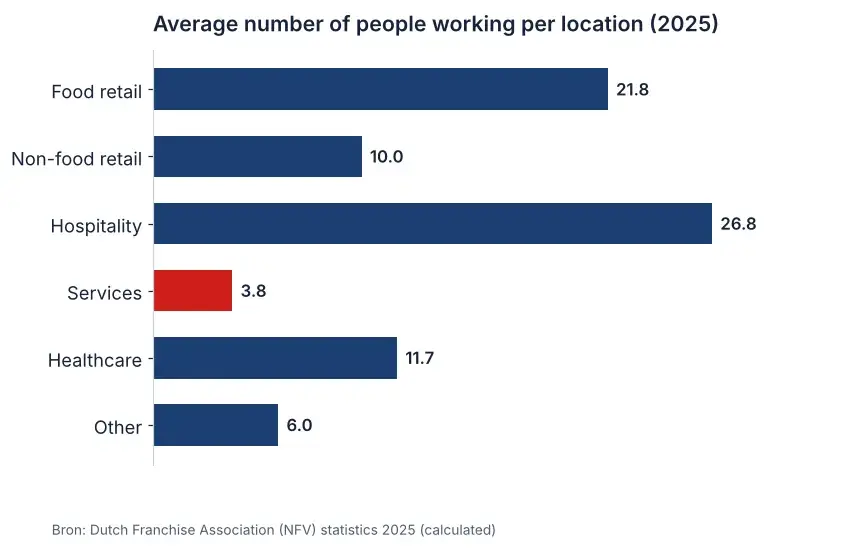
A home-based franchise is a franchise brand you run without a shop or restaurant premises, usually in services: advice, tutoring, cleaning, home services or online work. According to the NFV franchise statistics for 2025, service franchises employ an average of 3.8 people per location, compared with 26.8 in hospitality. So you start small, with lower fixed costs, but also with less turnover per location.
Which franchise brands can you run from home?
With home-based franchises your home is the office and you work at the customer's premises or online. No premises, but you do get a brand, a way of working and usually marketing support. Don't confuse it with network marketing: read about network marketing versus franchising. Want to see the whole journey first? Follow the step-by-step plan for starting a franchise.
| Type | What you need |
|---|---|
| Home services (odd jobs, gardening, childcare) | Transport, tools, scheduling |
| Advice and coaching | Expertise, laptop, a quiet workspace |
| Tutoring and homework support | Teaching experience, patience, free evenings |
| Cleaning | Transport, supplies, staff later on |
| Online services | Digital skills, self-discipline |
How large are service franchises in the Netherlands?
For 2025 the NFV counts 936 franchise brands with 34,937 locations in total. Services are the largest sector: 375 brands with 9,721 locations, 37,400 people employed and €4.7 billion in turnover. That is where most home-based franchises sit. Per location this works out at an average of 3.8 people and €0.48 million in turnover, smaller than shops and hospitality. To see how such brands reach customers, read about franchise marketing for service brands.
| Sector | People employed per location | Turnover per location |
|---|---|---|
| Services | 3.8 | €0.48m |
| Non-food retail | 10.0 | €1.75m |
| Care | 11.7 | €1.27m |
| Food retail | 21.8 | €2.91m |
| Hospitality | 26.8 | €1.23m |
What are the pros and cons of home-based franchises?
Working from home sounds like freedom, and in part it is. But without a shop you have to find customers yourself, and work and private life start to blur.
| Advantage | What it means for you |
|---|---|
| No rent or refurbishment | Lower fixed costs and a smaller investment |
| Flexible working hours | Easier to combine with family or another job during the start-up phase |
| Proven way of working | No need to build your own method, brand or software |
| Point to watch | Why it matters |
|---|---|
| No walk-in or passing trade | Without a shop window everything depends on online visibility and word of mouth |
| Lower turnover per location | Royalties and the marketing contribution weigh relatively heavily |
| Work and private life blur | Without a fixed workspace and hours you can easily become overloaded |
No time or expertise in-house? Leave your franchise marketing to us.
What do franchise brands you run from home cost?
Dutch averages per type are not available. A 2025 French market study by IntoTheMinds (21 franchise brands) gives ranges: an entry fee of €0 to €50,000, royalties of 0% to 9% of turnover (usually 4% to 6%) and a marketing contribution of 0% to 3%. That is a French sample; Dutch franchise brands may differ. At home the cost of premises and fit-out largely disappears, but do ask for a full breakdown. Read more about entry fees and royalties under what a franchise costs.
The fictional worked example shows that percentages weigh heavily on a small turnover.
| Item | Fictional amount |
|---|---|
| Turnover | €60,000 |
| Royalty 5% | €3,000 |
| Marketing contribution 2% | €1,200 |
| Own local marketing | €2,400 |
| Car, software, insurance | €7,000 |
| Left before tax and your own income | €46,400 |
Financing a small start
Little savings? Qredits offers a microcredit of up to €50,000 with a term of 1 to 10 years. Read more about financing for new franchisees.
How do customers find a home-based franchise without a shop?
Without a shop window, your Google Business Profile is your front door. Our Local SEO Benchmark Franchise Chains 2026 (500 profiles from 100 chains) shows that only 40% are fully completed and that just 6 of the 100 chains respond to reviews within 24 hours. See how franchise brands handle this centrally under managing Google Business Profiles.
A service area instead of an address
If you don't receive customers at home, you can set a service area in your profile and hide your home address. Customers then see where you work, not where you live. Only add places you genuinely serve.
Ask how the brand handles local marketing
Before you sign, ask how the franchise brand handles local marketing per location. Who manages your profile and who responds to reviews? A vague answer means you will have to do it yourself. Are you a franchisor? Request a free scan of three locations.
What should you check in a home-based franchise agreement?
A home-based franchise also falls under the Dutch Franchise Act (in force since 1 January 2021). Under Article 7:911 of the Dutch Civil Code you get the right and the obligation to operate a franchise system in return for a fee. The franchisor must inform you in advance, including about fees and required investments (Articles 7:913 and 7:916 of the Dutch Civil Code). This is followed by a four-week standstill period before you may sign. Changes to the franchise system with financial consequences above an agreed threshold require franchisee consent (Article 7:921 of the Dutch Civil Code).
For home-based work, ask above all how your territory is defined and what happens if you want to stop. Have your contract reviewed by a franchise lawyer; this is not legal advice.
What does starting a home-based franchise look like?
A fictional example: teacher Sanne starts a tutoring franchise from home in her region, alongside her job, ten hours a week. All the steps involved in becoming a franchisee are on that page.
| Moment | Action |
|---|---|
| Orientation | Compare three franchise brands on costs and territory |
| After disclosure | Use the four-week standstill for the numbers and a legal review |
| After signing | Dutch Chamber of Commerce (KvK) registration, insurance, set up a workspace |
| Month 1 | Google Business Profile with service area, first customers through your network |
| Month 3 | Ask for reviews and compare the numbers with the plan |
Frequently asked questions about a home-based franchise
Can I combine a home-based franchise with a job?
May I receive customers at my home with a franchise?
Is a home-based franchise cheaper than a franchise with a shop?
How much can you earn with a home-based franchise?
What is the difference between a home-based franchise and network marketing?
Does my home address have to be visible on Google?
How large is my territory with a home-based franchise?
What qualities do you need to run a franchise from home?
Can I hire staff later with a home-based franchise?
Is services a large franchise sector?
Sources
- NFV (Dutch Franchise Association): franchise statistics, 2025
- IntoTheMinds: market study of franchise costs (French sample, 2025)
- Overheid.nl: Dutch Civil Code book 7, title 16 franchise
- CMS: no information, no franchise (standstill period)
- Dirkzwager: the Dutch Franchise Act in practice
- KVK (Dutch Chamber of Commerce): microcredit, the loan of up to €50,000
- Franchise-Marketing.nl: Local SEO Benchmark Franchise Chains 2026

Gijs Bodenstaff
Franchise marketer, local SEO and GEO specialist, author
Not sure which home-based franchise suits you? Write your questions down and hold them against the checklist on this page.