
The key difference between network marketing and franchising: a franchisee operates a proven franchise brand from their own location and earns from customers, while a network marketer sells products through a network and often also earns from recruiting new sellers. In the Netherlands, franchising is governed by the Dutch Franchise Act (Title 16 of Book 7 of the Dutch Civil Code, in force since 1 January 2021). Network marketing is permitted, but a pyramid scheme in which earnings come mainly from recruitment is prohibited as an unfair commercial practice. This is general information, not legal or financial advice.
What is franchising and what is network marketing?
Franchising, under Article 7:911 of the Dutch Civil Code, is an agreement in which the franchisor, in return for payment, grants the franchisee the right and imposes the obligation to operate a franchise brand. In the Netherlands there are 936 franchise brands with 34,937 locations (NFV, 2025).
Network marketing, also known as multi-level marketing, is a sales model in which independent sellers sell products to their own network and often receive a commission on the sales of people they have recruited themselves.
Network marketing and franchising side by side
The differences lie in what you buy, what you earn from and which rules apply.
| Aspect | Franchise | Network marketing |
|---|---|---|
| What you get | Right to the franchise brand, trademark and support | Right to sell products |
| Location | Usually a fixed location or territory | No fixed location |
| Earnings model | Revenue from customers | Sales plus commission on the network |
| Investment | Often substantial (fit-out, fee) | Usually low (starter kit) |
| Legislation | Dutch Franchise Act, Title 7.16 of the Dutch Civil Code | General law; pyramid schemes prohibited |
| Marketing | National brand plus local marketing per location | Personal network and social media |
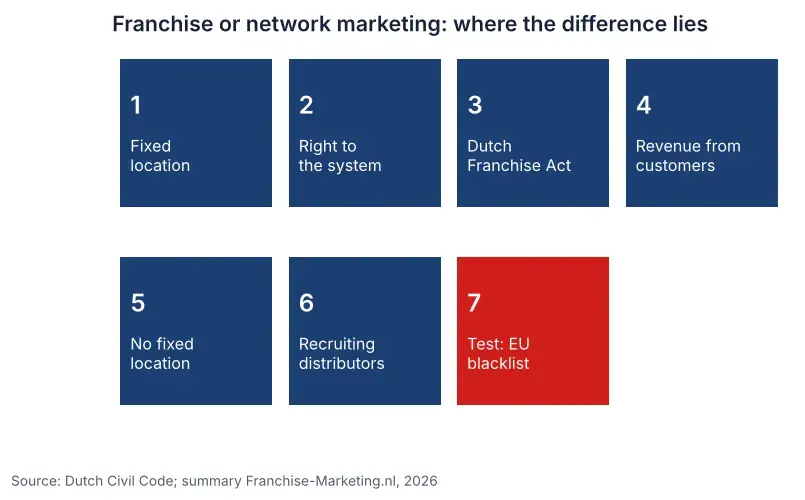
What does the law say?
The Dutch Franchise Act gives franchisees the right to information in advance, including on fees and investments (Articles 7:913 and 7:916 of the Dutch Civil Code), and a right of consent for certain changes to the franchise brand with financial consequences (Article 7:921 of the Dutch Civil Code). There is no separate law for network marketing. However, setting up or promoting a pyramid scheme, in which participants pay mainly for bringing in new participants rather than for the sale of products, is on the European blacklist of unfair commercial practices (Directive 2005/29/EC, Annex I). In the Netherlands, that list has been incorporated in Article 6:193g of the Dutch Civil Code. In doubt about an offer? Ask a lawyer for advice.
How does the marketing differ?
In franchising, marketing revolves around the brand and around visibility per location: Google Maps, reviews and local campaigns. In network marketing, it revolves around the seller's personal network and social media. As a result, the skills and budgets involved are very different. Read what franchise marketing is for the fundamentals of franchise marketing and the national and local marketing split for how the work is divided.
What should you look for when choosing?
- Do you earn mainly from customers or from recruitment? If the latter: be careful.
- Do you receive written information on costs and investments in advance?
- Is there a proven franchise brand with locations that are already up and running?
- Who pays for and manages the marketing, and how is it accounted for?
If you are considering a franchise brand, see the franchisee marketing contribution to find out how the marketing contribution works.
Warning signs to look out for in an offer
Whether you are looking at a franchise or a network marketing offer, watch for signs that point to an unhealthy model. A trustworthy party provides written information, lets you talk to existing participants and earns mainly from products or services that customers genuinely buy. If in doubt, talk to a lawyer or accountant before you sign.
| Sign | Why it matters |
|---|---|
| Earnings come mainly from recruitment | Characteristic of a pyramid scheme |
| High entry costs without a clear return | Risk of losing money |
| No written information in advance | A legal requirement in franchising |
| Pressure to sign quickly | No time for proper review |
| Sign | What it tells you |
|---|---|
| Locations that have been running for years | The franchise brand is proven |
| Transparent marketing contribution | You know where your money goes |
| Reporting per location | Results are measurable |
| Active franchisee advisory council | Franchisees have a say |
The difference in earnings model, with a worked example
The difference in earnings model becomes clear with a simple, fictitious example. A franchisee with a shop earns from the margin on what customers buy, minus the costs of rent, staff, purchasing and the fees paid to the franchisor. Their revenue grows as more customers come in; local visibility and a good franchise brand are essential for that.
A network marketer earns from the products they sell themselves and, in many models, also a percentage of the sales made by people they have recruited. As long as the income comes mainly from sales to genuine end customers, that is a legitimate model. If earnings come to depend mainly on recruiting new participants, who in turn have to pay to take part, it shifts towards a prohibited pyramid scheme.
So with every offer, ask: where does the money ultimately come from, customers or new participants? For a franchise brand, the answer should always be ‘from customers’. Franchisors who want to grow that flow of customers per location will find the basics in Google Business Profile management.
For franchisors, this distinction also matters commercially. Prospective franchisees who do not know the difference sometimes drop out because they lump franchising together with earnings models that have a bad reputation. So explain clearly in your recruitment material how the franchise brand makes money, what a franchisee invests and what information they receive in advance under the Dutch Franchise Act. Transparency about figures, a conversation with existing franchisees and a clear explanation of the marketing contribution remove a lot of doubt. Ultimately, that delivers better candidates, who know what they are choosing and therefore also stay longer.
| Model | Main source of income | When to look critically |
|---|---|---|
| Franchise | Sales to customers at the location or in the territory | If the franchise brand is not proven |
| Network marketing | Own product sales plus commission on the network | If recruitment becomes more important than sales |
For franchisors: recruiting without confusion
Franchisors looking for new franchisees would do well to make the difference clear: a fixed location, a proven franchise brand and transparent costs. That builds trust. See a franchisee recruitment campaign and recruitment marketing for franchisors.
Frequently asked questions: network marketing vs franchise?
What is the difference between network marketing and franchising?
Is network marketing legal in the Netherlands?
Is franchising safer than network marketing?
Is network marketing the same as multi-level marketing?
How does marketing differ in franchising?
Which information must a franchisor provide in advance under the Dutch Franchise Act?
How do you recognise a pyramid scheme in a network marketing offer?
How much do you invest in a franchise compared with network marketing?
As a franchisor, how do you explain that your franchise is not network marketing?
How do you recognise a healthy franchise as an alternative to network marketing?
Sources

Gijs Bodenstaff
Franchise marketer, local SEO and GEO specialist, author
More on the basics: what a franchise is.
Are you a franchisor who wants to make your franchise brand easier to find? Book a call.