
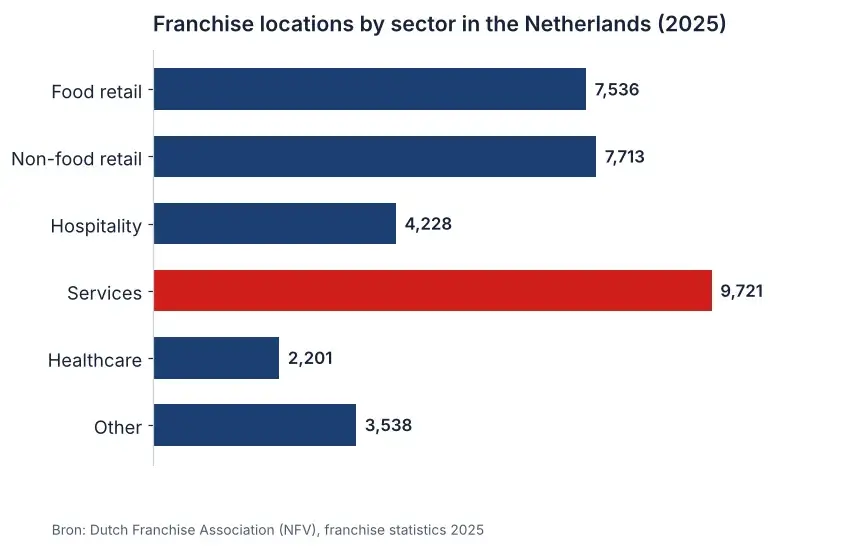
Franchise marketing is all the marketing of a franchise brand: the franchisor's national brand campaigns and the franchisees' local marketing for each location. The aim is for the brand to make the same promise everywhere and for every location to attract customers in its own neighbourhood. In the Netherlands this involves 936 franchise brands with a combined 34,937 locations and €50.5 billion in turnover (Dutch Franchise Association (NFV), reference year 2025). On this page you can read what franchise marketing means, how it differs from ordinary marketing and who does and pays for what.
What exactly does franchise marketing mean?
Franchise marketing means making one brand work for dozens or hundreds of independent business owners at the same time. The franchisor builds the brand and the franchise system. The franchisee runs a location and has to be found and chosen in their own catchment area. Marketing is therefore always an interplay between two levels.
The law describes franchising as the right and the obligation to operate a franchise system in return for payment (Article 7:911 of the Dutch Civil Code). Marketing is a fixed part of that franchise system: the house style, campaigns, the website and the agreements on who does what are usually set out in the franchise agreement or the operations manual. You can read more about the contribution itself under franchisees' marketing contribution.
How does it differ from ordinary marketing?
An ordinary business has one decision-maker and one budget. A franchise brand has a head office as well as independent business owners, each with their own interests. On top of that, Google assesses every location separately: a location in Zwolle can rank at the top while the one in Breda cannot be found.
National and local franchise marketing: who does what?
Head office arranges what applies to everyone; the location does what can only be done on the spot. How you divide those tasks determines whether the marketing works.
| Element | Head office (franchisor) | Location (franchisee) |
|---|---|---|
| Brand and house style | Develops and protects | Applies |
| National campaigns | Plans and pays from the fund | Joins in with local activity |
| Website and location pages | Builds centrally | Supplies local info and photos |
| Google Business Profile | Manages centrally or directs | Keeps details and photos up to date |
| Reviews | Sets the process and response time | Replies or has replies written |
| Local promotions and sponsorship | Supplies templates | Carries them out in the neighbourhood |
Franchise marketing in figures
Franchising is big in the Netherlands, and most locations rely on customers from their immediate surroundings. That is exactly where many chains leave opportunities untapped.
| Key figure | Value |
|---|---|
| Franchise brands | 936 |
| Locations | 34,937 |
| Turnover | €50.5 billion |
| People employed | 438,800 |
| Largest sector by number of locations | Services (9,721) |
| Measurement | Result |
|---|---|
| Google Business Profiles fully completed | 40% of 500 |
| Chains that reply to reviews within 24 hours | 6 out of 100 |
| Chains without a demonstrable review process | 90% |
What are the components of franchise marketing?
The core consists of six components. You need all of them, but the order differs per franchise brand.
- Strategy and positioning, set out in a national and local marketing strategy.
- Local visibility in Google Maps and search results; see location visibility in Google Maps.
- AI visibility: being mentioned in ChatGPT, Gemini and AI Overviews.
- Reviews per location, with a fixed response time.
- Campaigns: Google Ads, social media and email, nationally and per location.
- Reporting per location, so franchisees can see what their contribution delivers.
What does the Dutch Franchise Act say about marketing?
The Dutch Franchise Act has applied since 1 January 2021. The franchisor must provide information in advance and during the relationship on matters including fees and required investments (Articles 7:913 and 7:916 of the Dutch Civil Code). If the franchisor wants to change the franchise system with financial consequences above a pre-agreed threshold, the consent of franchisees is required (Article 7:921 of the Dutch Civil Code). For marketing this means: be open about the marketing contribution and how it is spent. This is not legal advice; have your contract reviewed by a franchise lawyer.
Three misconceptions about franchise marketing
Misconception 1: the brand is enough. A well-known brand helps, but anyone searching for ‘bakery near me’ or ‘physiotherapist Amersfoort’ is shown the location with the best profile, not automatically the best-known brand. Brand awareness without local visibility delivers customers to the competitor who is visible.
Misconception 2: local marketing is something for the franchisee to handle. In theory, yes; in practice, time and knowledge are lacking. A business owner who is in their shop all day does not answer reviews at ten o’clock at night. Franchise brands that handle the basic local work centrally get more out of the same budget, because every location receives the same quality.
Misconception 3: more budget solves it. Extra advertising budget increases reach, but if the Business Profile is out of date or complaints go unanswered, that reach leaks away. Basics first, then scale up: that order saves money and delivers results faster. If you want to know what such an approach looks like per location, read a marketing agency for multi-location businesses.
The common thread: franchise marketing succeeds when head office and the location each do what they are good at, with clear agreements and figures per location as a shared language.
A handy way to explain franchise marketing to new franchisees is the comparison with an orchestra. Head office writes the score: the brand, the campaigns and the agreements. Each location plays its own part in its own hall, for its own audience. If everyone follows the same score but also listens carefully to the hall, it sounds recognisable everywhere and yet local. If a location plays something completely different, the customer no longer recognises the brand; if a location follows only the score without looking at the hall, it misses the customers around the corner. That balance between unity and local colour is the core of the craft, and at the same time the reason why an ordinary marketing plan for a single business falls short here.
How do you get started with franchise marketing?
Start small and measurable. Choose three locations, measure how they are doing in Google and AI, improve the basics and compare after a quarter. You can do that with a free analysis of your locations. For the next steps, an annual franchise marketing plan helps. Prefer to hand it all over in one go? Read how outsourcing franchise marketing works.
Frequently asked questions: what is franchise marketing?
What is franchise marketing in one sentence?
Who pays for franchise marketing?
What is the difference between franchise marketing and local marketing?
Is franchise marketing more expensive than ordinary marketing?
Do I need an agency as a franchisor?
How big is franchising in the Netherlands?
What role does the Dutch Franchise Act play in what franchise marketing means?
Which components make up franchise marketing?
Is a well-known brand enough to attract local customers?
How well do Dutch franchise chains perform on local visibility?
Sources
- Nederlandse Franchise Vereniging (Dutch Franchise Association), Franchise statistics (reference year 2025)
- Local SEO Benchmark Franchise Ketens 2026: original research by LocalSEOLab.nl and GijsBodenstaff.nl with Stichting LODAK (500 Google Business Profiles of 100 chains)
- Dutch Franchise Act, Dutch Civil Code Book 7, Title 16 (wetten.overheid.nl)
- Dirkzwager advocaten (law firm), article on the Franchise Bill and its practical consequences (part V)

Gijs Bodenstaff
Franchise marketer, local SEO and GEO specialist, author
New to franchising? First read what a franchise is.
Want to know how your locations are performing? Request the free scan.