
A franchise is a partnership in which an independent entrepreneur (the franchisee) uses the brand and way of working of another business (the franchisor) in return for a fee. Dutch law describes it in Article 7:911 of the Dutch Civil Code as the right and the obligation to operate a franchise system in return for a fee. The model is large: in 2025 the Dutch Franchise Association (NFV) counted 936 franchise brands in the Netherlands.
What exactly does franchise mean?
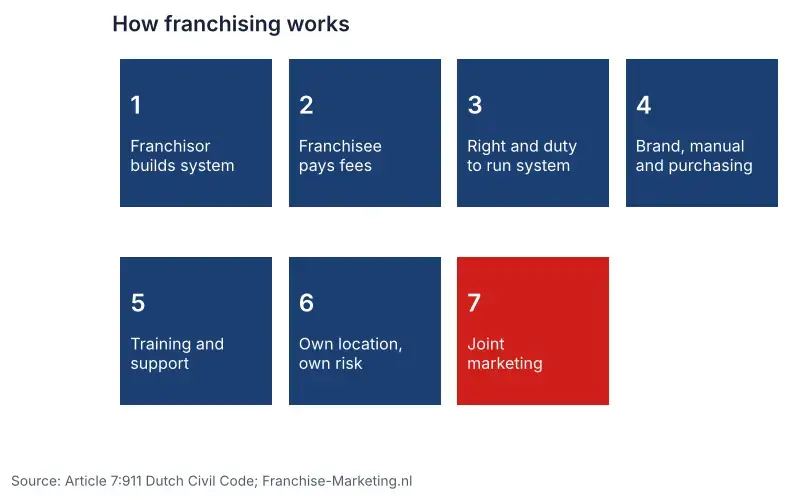
The word comes from French and refers to a privilege or exemption. In practice it is about a fixed division of roles. The franchisor has developed a system: brand, products or service, purchasing, house style and way of working. The franchisee opens their own location, invests their own money and follows the system. The key point is that it is a right and an obligation: you may use the system, but you must also stick to it. Want to get started yourself? Read the step-by-step plan for starting a franchise.
| Role | Contributes | Gets in return |
|---|---|---|
| Franchisor | Brand, way of working, training, purchasing, national marketing | Fees and growth of the brand |
| Franchisee | Capital, labour, local entrepreneurship | A proven system and support |
How do franchise systems work in practice?
A franchise system runs on arrangements set out in the franchise agreement. At the start you often pay an initial fee, then ongoing royalties on your turnover and usually a marketing contribution. What those items cost in practice is explained under entry fee, royalties and investment. The marketing contribution often goes into a shared fund; read how a marketing fund works. In return you get training, an operations manual, purchasing benefits and a brand customers already know. Before you sign, the Dutch Franchise Act requires the franchisor to give you information in advance on matters including fees and required investments, after which a four-week standstill period applies.
What is the difference between a franchise, a licence, an agency and a branch?
Franchising is often confused with other forms of partnership. The difference lies in who owns the business, who carries the risk and how far the arrangements on the way of working go. Network marketing can look similar at times, but works very differently; read the difference between network marketing and franchising.
| Form | Who owns the location | How far the way of working goes |
|---|---|---|
| Franchise | The franchisee, as an independent entrepreneur | The full system: brand, way of working and support |
| Licence | The licensee | Usually only the right to use a brand, product or technology |
| Agency | The agent works on behalf of the principal | The agent brokers or sells on behalf of someone else, often on commission |
| Branch | The parent company itself | Fully centrally managed, with a salaried branch manager |
No time or expertise in-house? Leave your franchise marketing to us.
Which franchise businesses and examples do you see in the Netherlands?
Franchising is found in more sectors than you might think: from supermarkets and bakeries to hair salons, estate agents, tutoring agencies and childcare. Based on the NFV figures for 2025 you can see big differences in scale. An overview of franchise chains in the Netherlands by sector is on a separate page.
| Sector | Locations per brand | People in work per location |
|---|---|---|
| Food retail | 66 | 21.8 |
| Non-food retail | 43 | 10.0 |
| Hospitality | 27 | 26.8 |
| Services | 26 | 3.8 |
| Care | 58 | 11.7 |
| Other | 49 | 6.0 |
A franchise example worked out
Fictitious example: a tutoring brand has a method, teaching materials, a booking system and a national website. Mark opens a location in his region as a franchisee. He recruits tutors himself, finds pupils and pays the brand a fee on his turnover. The brand, the teaching method and the software come from the franchisor.
What does a franchise entrepreneur do?
A franchise entrepreneur is not an employee but an independent entrepreneur with their own business. You hire staff, keep an eye on the figures and build customer relationships, within the boundaries of the system. Wondering whether that suits you? Read more about the step to becoming a franchisee.
| You have the right to | You have the obligation to |
|---|---|
| Use the brand and the system | Follow the system and house style |
| Advance information on fees and investments | Pay the agreed fees |
| Training and support as agreed | Run and finance your location yourself |
| Consent on certain system changes with financial consequences | Honour the contract, even after a setback |
Which misconceptions about franchises do you often come across?
- A franchise is always a large chain. According to the NFV, around 80% of brands are SMEs, with no more than 50 locations.
- The franchisor is your boss. You are an independent entrepreneur and carry the financial risk yourself.
- You cannot decide anything yourself. The system is fixed, but staff, service and local contacts are your job.
- The contract is standard. Have your contract reviewed by a franchise lawyer; this is not legal advice.
How does marketing work within a franchise chain?
Usually head office handles the national campaigns and you are responsible for local visibility. Read what franchise marketing is if you want to understand the division of tasks. In our Local SEO Benchmark Franchise Ketens 2026, only 40% of 500 Google Business Profiles were fully completed. So ask the brand how it handles local marketing for each location. Are you a franchisor and want to discuss this? Get in touch with us.
Frequently asked questions about what a franchise is
What is the meaning of franchise in one sentence?
What is a franchisor?
What is a franchisee?
Is a franchisee employed by the franchisor?
What is the difference between a franchise and a branch?
What is the difference between a franchise and a licence?
What is an example of a franchise?
How many people work in franchising in the Netherlands?
What is a franchise agreement?
Are franchise businesses always large chains?
Sources
- Overheid.nl, Dutch Civil Code Book 7, Title 16 (Dutch Franchise Act)
- NFV, franchise statistics for reference year 2025
- CMS, on pre-contractual information and the standstill period
- Dirkzwager, on the franchise bill: consequences in practice (part V)
- Franchise-Marketing.nl, Local SEO Benchmark Franchise Ketens 2026
Gijs Bodenstaff
Franchise marketer, local SEO and GEO specialist, author
Now that you know what a franchise is, read on about the costs and the steps to start one yourself.