
The biggest franchise marketing opportunities are not in new channels, but in what most chains leave untouched: visibility per location in Google Maps and AI assistants, and reviews that are answered on time. In our benchmark of the 100 largest Dutch chains, only 40% of 500 Google Business Profiles were fully completed. At the same time, AI use is growing: according to Statistics Netherlands (CBS), almost half of 18 to 24-year-olds were already using generative AI in 2023. Below are six opportunities for 2026 and 2027, each with a first step.
Opportunity 1: being mentioned in AI answers
AI assistants give a short list in response to a local question. Whoever is on that list gets the customer. The opportunity: publish clear, quotable information for each location. First step: test ten questions customers ask and note which locations are mentioned. More in GEO and AI visibility.
Opportunity 2: getting the basics right in Google Maps
Complete profiles, correct categories and up-to-date opening hours seem simple, yet 60% of the profiles studied were incomplete. First step: check three locations for every field. See outsourcing local SEO.
Opportunity 3: reviews as a competitive advantage
Only 6 of the 100 chains responded within 24 hours. Those that do stand out to customers comparing profiles. First step: agree a response time and measure it. See reviews answered within 24 hours.
Opportunity 4: data per location
Franchise brands that measure per location can see where budget pays off and where it does not. That makes the discussion about the marketing fee factual. First step: one monthly report per location. See measuring ROI per franchise location.
Opportunities 5 and 6: sector opportunities and recruitment
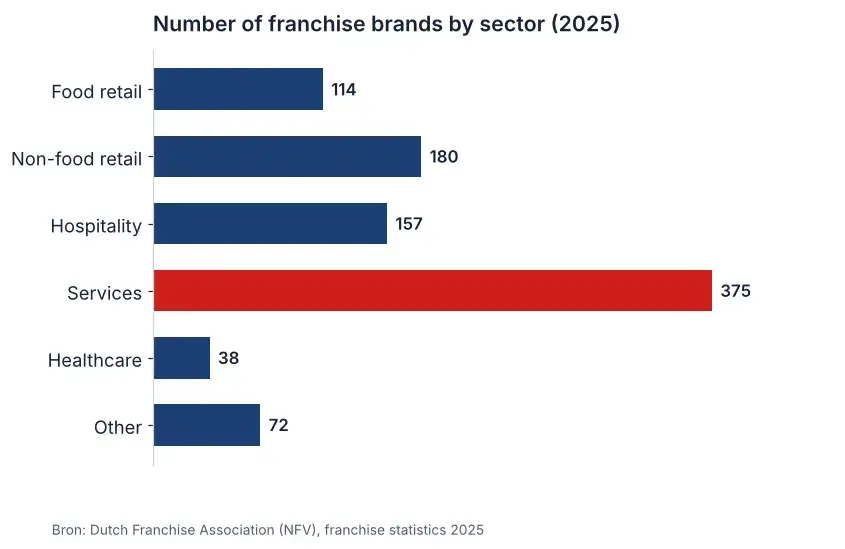
Service businesses have the most franchise brands and locations, but the lowest revenue per location. There, local visibility is often the difference between a full diary and an empty one. And if you are looking for new franchisees, you can use the same online visibility for recruitment; see franchise recruitment marketing services.
| Sector | Brands | Locations | Revenue |
|---|---|---|---|
| Food retail | 114 | 7,536 | €21.9bn |
| Non-food retail | 180 | 7,713 | €13.5bn |
| Hospitality | 157 | 4,228 | €5.2bn |
| Service businesses | 375 | 9,721 | €4.7bn |
| Healthcare | 38 | 2,201 | €2.8bn |
| Other | 72 | 3,538 | €2.4bn |
What are the risks if you miss these opportunities?
Every opportunity has a flip side. If you stand still, you lose customers to competitors who do act, often without noticing: the customer searches, finds someone else and never walks through your door. You will not see that loss in your own figures, but you will see it in stagnating revenue per location. You can work out how much difference that makes with the lost revenue per location calculation. So do not just measure your own results, but compare them with two or three competitors in the same area. That shows you where you are losing ground.
A practical way to start is a quarterly plan with one opportunity per month. Month one: complete the profiles of all locations. Month two: a review process with a fixed response time. Month three: the first measurement in AI assistants and a report per location. After three months, the foundations are in place and you can use figures to decide which opportunity to develop further. This stops the organisation trying to do everything at once and ultimately finishing nothing, and franchisees see something change within a few weeks.
| Opportunity | Risk if you do nothing |
|---|---|
| AI answers | A competitor is mentioned, you are not |
| Google Maps | The location slips out of the local pack |
| Reviews | Customers choose the business with recent responses |
| Data per location | Budget leaks away to locations without a return |
| Online recruitment | Growth of the franchise brand stalls |
What does the AI opportunity look like in practice?
The opportunity in AI search engines is more concrete than it sounds. Suppose someone asks ChatGPT or Gemini which childcare centre in a particular neighbourhood has places available and good reviews. The answer contains a few names, with a short explanation. That explanation comes from information about the location that can be found online: the Business Profile, reviews and the location page.
A location with a complete page that answers parents' questions directly is more likely to be mentioned than a location with only an address and opening hours. The work per location is small, but it has to be done for every location. That is why it pays to create a fixed format, with questions that recur per sector, and to fill it centrally with local details from the franchisee.
Measure the opportunity before you start: note which locations are already being mentioned and which competitors appear in the answers. Repeat the test after three and six months. For the whole team, this is also a good topic for a Local SEO & GEO workshop for chains.
Choose the questions you test from the customer's point of view. Think of ‘which [service] in [town] is open on Sunday’, ‘which [shop] nearby has good reviews’ or ‘where can I go in [neighbourhood] for [problem]’. Run those questions for a few locations in different regions, so you can see whether the brand performs equally well everywhere. It often turns out that locations in larger cities are mentioned less often, because competition there is fiercer. That is exactly where extra attention to the location page and reviews pays off most. Record the results in a simple monthly table, so you see the trend rather than a single snapshot.
Combine this test with the profile score and reviews of the same locations. Then you can see whether a location that is rarely mentioned is also lagging behind in Google Maps, and you can solve both problems at once with a single approach.
Which opportunity should you tackle first?
Choose based on effort and impact. Quick wins are almost always found in the basics.
| Opportunity | Effort | Impact | Timeframe |
|---|---|---|---|
| Google Maps basics | Low | High | 1 to 3 months |
| Reviews within 24 hours | Medium | High | Immediately visible |
| Data per location | Medium | Medium | 1 quarter |
| AI answers | Medium | High and growing | 3 to 6 months |
| Online recruitment | High | High when growing | 6 months or more |
Frequently asked questions: franchise marketing opportunities
What is the biggest opportunity in franchise marketing?
Why is AI an opportunity for franchise brands?
Are there opportunities for small franchise brands?
Which sector has the most opportunities?
How do I discover the opportunities for my franchise brand?
Which franchise marketing opportunity should you start with in a quarterly plan?
What is the risk if a franchise brand leaves these marketing opportunities untouched?
How do you test whether your brand's locations are mentioned in ChatGPT or Gemini?
Why is data per location an opportunity for franchisors?
Can you also use your brand's online visibility to recruit franchisees?
Sources
- Dutch Franchise Association (Nederlandse Franchise Vereniging, NFV), Franchise statistics (reference year 2025)
- Local SEO Benchmark Franchise Chains 2026: original research by LocalSEOLab.nl and GijsBodenstaff.nl with Stichting LODAK (500 Google Business Profiles across 100 chains)
- Statistics Netherlands (CBS), Nearly a quarter of Dutch population use AI programs such as ChatGPT (3 September 2024)

Gijs Bodenstaff
Franchise marketer, local SEO and GEO specialist, author
Want to know which opportunities your locations are missing? Request the free scan.