
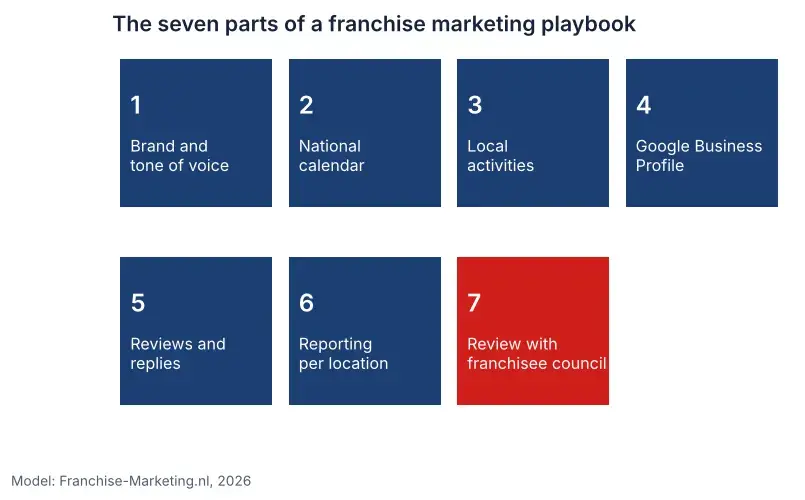
A franchise marketing playbook is the practical manual that sets out how marketing works within the franchise brand: what head office does, what the franchisee does, which templates are available and how you measure results. It differs from the operations manual because it focuses solely on marketing and is updated every quarter. A good playbook stops every location from reinventing the wheel. Below are the seven components, a table of contents and the process.
The seven components of a franchise playbook
Each component answers one question from the franchisee: what do I need to do, when and how?
| Component | Question it answers | Owner |
|---|---|---|
| 1. Brand and tone of voice | How do we sound and look? | Head office |
| 2. National calendar | Which campaigns are coming up? | Head office |
| 3. Local campaigns | What am I allowed to do myself? | Location within guidelines |
| 4. Google Business Profile | Who manages what? | Head office |
| 5. Reviews and responses | How quickly and how do I respond? | Agreed per franchise brand |
| 6. Reporting per location | What does it deliver? | Head office |
| 7. Evaluation with the franchisee advisory council | What do we improve? | Together |
A table of contents you can adopt
- Introduction: the purpose of marketing within the franchise brand.
- Roles: head office, location, agency.
- Brand: logo, colours, tone of voice, examples.
- Annual calendar and campaigns.
- Local marketing: permitted, not permitted, templates.
- Google Business Profile: what the location supplies.
- Reviews: response time, tone, escalation.
- Social media and email.
- Measurement and reporting.
- Contact and questions.
The process: from document to habit
A playbook sitting in a folder does not work. It has to come back in day-to-day work: in the onboarding of new franchisees, in the monthly report and in the evaluation with the franchisee advisory council. Put the key agreements in a short monthly checklist and refer from the report to the relevant chapter. Read more about training under marketing training for franchisees.
Local freedom for franchisees within guidelines
Franchisees want room for their own initiative. Give them that room, but with clear boundaries: social media templates, a list of permitted campaigns and a fixed approval route. That keeps the brand identity intact; see also protecting brand consistency on social media. Franchisees not cooperating? Read when franchisees do nothing with marketing.
The playbook and the Dutch Franchise Act
The Dutch Franchise Act requires the franchisor to provide information on matters including fees and required investments (Articles 7:913 and 7:916 of the Dutch Civil Code). A playbook that makes clear what happens to the marketing contribution and what franchisees need to invest themselves helps with this. Do have legal texts reviewed by a franchise lawyer.
Which templates belong with the playbook?
The playbook describes what needs to happen; templates make it easy to actually do it. The less a franchisee has to come up with themselves, the greater the chance it gets done. Keep all templates in one place, for example in a brand portal, and refer to them from every chapter. Also agree how often the playbook is updated and who does it. A fixed version date on the front page shows that the document is alive. Keep a short change log so franchisees can see at a glance what is new. After each update, ask two or three franchisees for feedback: they are the first to notice what does not work in practice.
Start small if you do not have a playbook yet. A first version with the roles, the response time for reviews, the annual calendar and three templates can be ready within a few weeks and is immediately usable. Then expand it each quarter with the questions franchisees ask most often. That way the playbook grows with practice instead of remaining a theoretical document that nobody opens. Keep every version, so you can look back later at which agreement was introduced when and why.
| Template | Used for | Update |
|---|---|---|
| Social posts with space to fill in | Weekly local post | Monthly |
| Review response guideline | Replying to reviews | Quarterly |
| Open day script | Local campaign | Annually |
| Photo guideline | Photos in the Business Profile | Annually |
| Monthly report | Results per location | Fixed format |
| Role | Task |
|---|---|
| Marketing manager | Owner and final editing |
| Franchisee advisory council | Feedback and buy-in |
| Locations | Supply practical examples |
| Agency | Update visibility and reporting |
The playbook in the onboarding of new franchisees
The best moment to get a franchisee working with the playbook is before the location opens. Good habits then become the normal way of doing things from the start. Go through the key chapters during training: who does what, what the Business Profile looks like, how to respond to a review and where to find the templates. In the first week, have the new franchisee supply a few photos and create a first local post, with feedback from head office.
After the first month, schedule a short evaluation with the first monthly report to hand. What is going well, what takes more time than expected and what questions are there? Use those questions to add to the playbook; new franchisees often spot exactly the ambiguities that experienced colleagues no longer notice. That way every new location becomes an opportunity to improve the manual. Existing franchisees benefit too, because the answers to frequently asked questions become available to everyone.
After three months, also ask new franchisees for a short assessment of the playbook. Was it clear, what was missing and which templates did they actually use? That feedback is worth its weight in gold, because it reveals the language of everyday practice. Then write the playbook in that language: ‘how to reply to an angry customer’ rather than ‘reputation management guidelines’. The more recognisable the words, the more often the document gets opened. And the more often it is opened, the more the marketing agreements become a natural part of the work at the location.
| Moment | Component | Goal |
|---|---|---|
| Training before opening | Roles, brand, reviews, templates | Good habits from day one |
| Week 1 | Photos and first local post | Profile active straight away |
| Weeks 2 to 4 | Reviews and updates as agreed | Build a routine |
| After month 1 | Evaluation with monthly report | Add to the playbook |
Help with creating your franchise playbook
We write playbooks for franchise brands and train franchisees in using them. We base the visibility component on the Franchise Local SEO & GEO Handboek 2027 (Dutch-language edition). See also the marketing plan step by step and marketing ideas for locations.
Frequently asked questions: franchise marketing playbook?
What is a franchise marketing playbook?
How does it differ from the operations manual?
How long should a playbook be?
Who writes the playbook?
How do I make sure franchisees use the playbook?
Which seven components belong in a franchise marketing playbook?
Which templates go with a franchise marketing playbook?
How quickly can you have a first version of a franchise marketing playbook ready?
How do you use the marketing playbook when onboarding a new franchisee?
What does a franchise marketing playbook have to do with the Dutch Franchise Act?
Sources
Gijs Bodenstaff
Franchise marketer, local SEO and GEO specialist, author
Want a playbook your franchisees will actually use? We will help you create it.